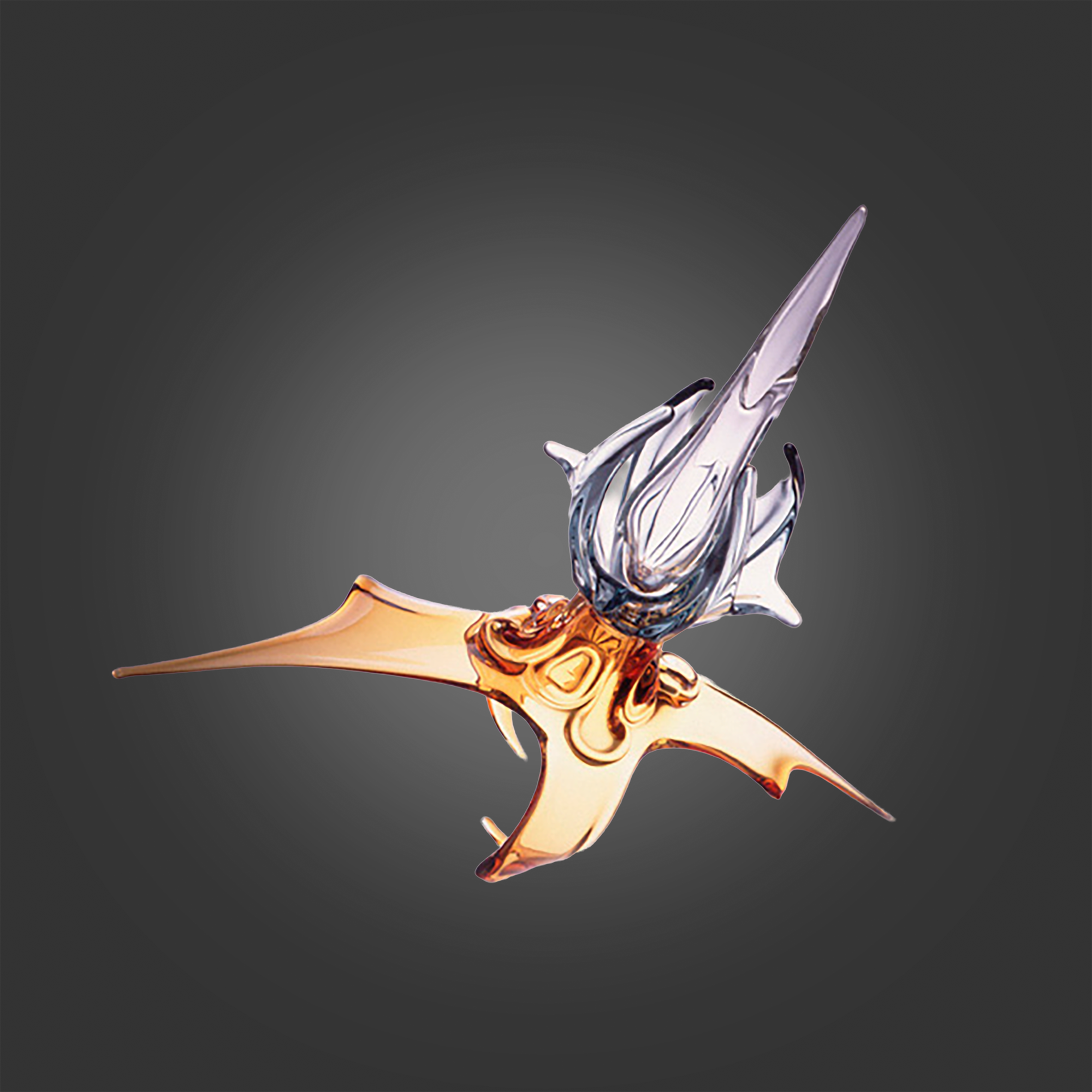
Arcturus
(31.5”L x 11.5”W x 29”H)
This StarSentient® sculpture is designed to hold a bold energy that pierces and soars above, eagle-like, utilizing a abroadly spread, very large golden, eight-pointed, clear central supporting structure upholding two clear compositional elements. Across cultures and eras, Arcturus consistently embodies for me authority standing at the threshold between myth and new discovery. As a fresh dynamic form in my repertoire, it dates to 2002 and therefore one of the oldest sculptures in the group and a new formulation, still unsurpassed in elegance with only three elements.
The StarSentient® sculpture, Arcturus, is named after the fourth brightest star in the Northern celestial hemisphere. Arcturus is the brilliant orange star anchoring the constellation Boötes, “The Herdsman,” and is a classic red giant. It is nearing the later stages of stellar evolution and has expanded vastly to roughly 25 times the Sun’s diameter while shining at about 150–200 times the Sun’s luminosity. While so much larger and brighter than our Sun, Arcturus is yet dwarfed by red supergiants such as Betelgeuse and Antares, which are hundreds of times wider and tens of thousands of times more luminous. It sits approximately 37 light-years from us, making it one of the closer larger stars. Still, it has been recorded as both substantially smaller and substantially larger, representing something of an anomaly. For this reason, it fits within the category of stars termed “variable.” This is not the only distinguishing characteristic of this star.
Known since antiquity, Arcturus was associated in Greek myth with Arcas, the celestial herdsman, and used by ancient Mediterranean cultures as a seasonal marker for planting and harvest. But it gets the name from the ancient Greek word for bear, which is ‘arktos + the word for guardian ‘ouros’ (=’arktouros’), because of its being in line with the tail of the Bear constellation, Ursa Major. So the name ‘Guardian of the Bear’ is a personified name and part of the star’s originating mythology. Medieval Latin astronomers largely preserved the ancient name Arcturus and the epithet. Still, in astrological manuscripts, it became considered a fortunate, commanding star, associated with leadership. It often marked the idea of a sentinel or watchman, reinforcing its role as a celestial overseer rather than a passive light. By this period, Arcturus had become one of the most important navigational stars in Europe.
In 1718, Edmond Halley discovered that Arcturus possesses unusually high “proper motion,” meaning it moves against the background stars over centuries - an extraordinary finding at the time. This scientific revelation reinforced Arcturus’ symbolic reputation as independent and dynamic, a star not fixed, but roaming.