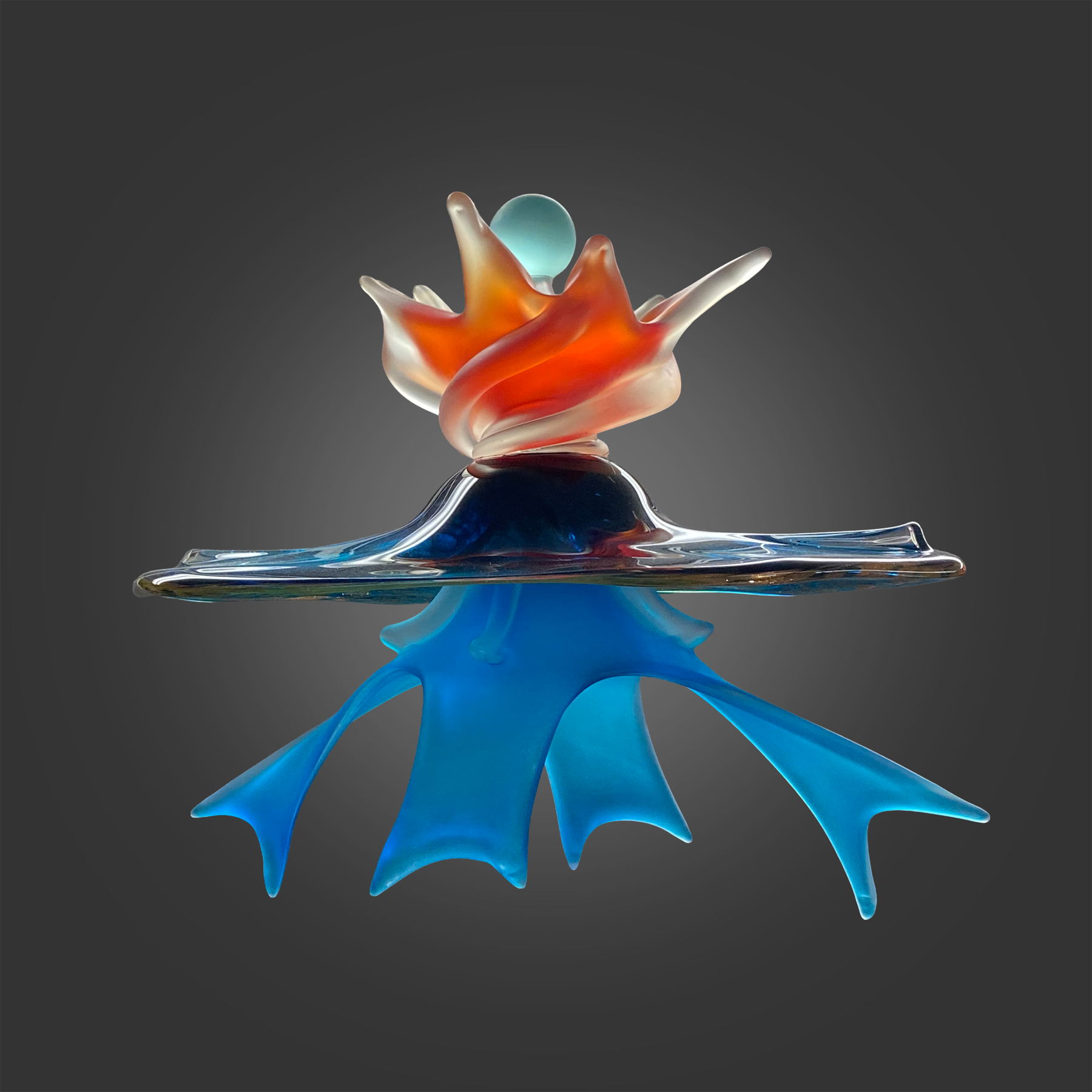
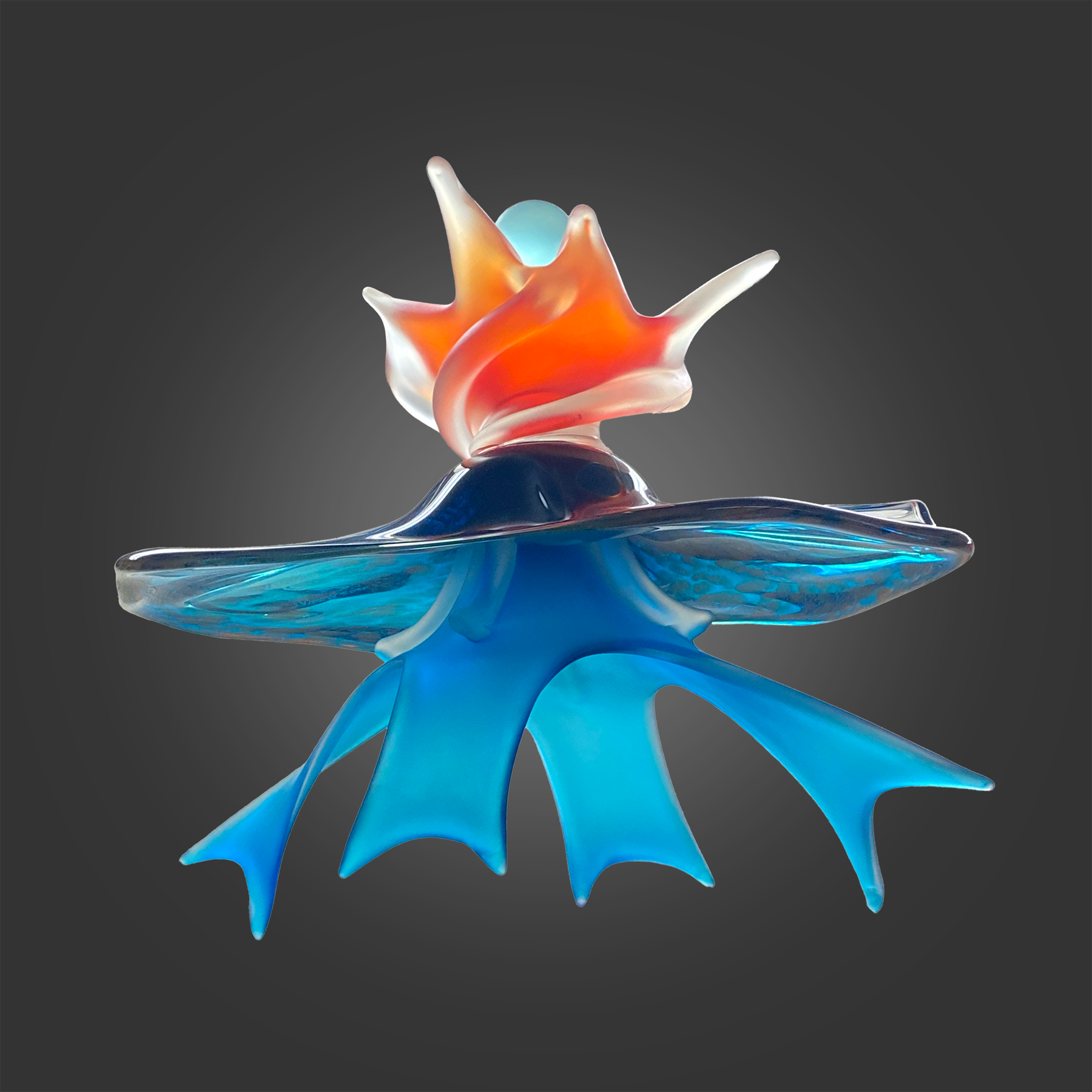
Taygeta
(20.5”L x 11”W x 17”H)
The StarSentient® sculpture Taygeta is named after one of the highly luminous stars of the Pleiades star cluster, located approximately 410–440 light-years from Earth in the constellation of Taurus. Visible to the naked eye as one of the famed “Seven Sisters,” Taygeta is not a single star, but a multiple-star system whose primary star is a hot, sub-giant, radiating a brilliant blue-white color more than 600 times more luminous than our Sun and over six times its size, with a diameter about 5 million miles. The principal stars of this system orbit one another as a close spectroscopic binary, indicating a powerful gravitational relationship. Taygeta is relatively young, likely around 100 million years old, because it formed along with the rest of the Pleiades cluster from the same immense molecular cloud of gas and dust. By comparison, the Sun is over 20 times older at 4.6 billion years. The nearby bright Pleiadian system stars closest to Taygeta include Maia, Celaeno, Electra, Atlas, and Pleione, all of which are gravitationally associated members of the open cluster and slowly travel together through space. The Pleiades overall contains more than a thousand stars bound by mutual gravity. No confirmed exoplanets have yet been detected orbiting Taygeta. The star does share a number of similarities with Merope, a bit further away at 5-10 light-years in the cluster and a bit smaller, but at a similar reference distance as Taygeta from Earth. Both are blue-white stars of very similar mass, size, and evolutionary stage, making them astrophysical near cousins and among the most luminous naked-eye stars in the cluster. The Pleiades is famous for its delicate blue reflection nebulosity, caused by the cluster passing through an interstellar dust cloud that reflects the stars’ light.
In Greek mythology, Taygeta was one of the seven daughters of Atlas and Pleione (the Seven Sisters), transformed into stars by Zeus. So the name “Taygeta” carries both a celestial and a mythic lineage reaching back to antiquity. In modern astronomy, the star became formally standardized under this ancient name by the International Astronomical Union in 2016, continuing a tradition that links observational science with some of humanity’s oldest sky legends.